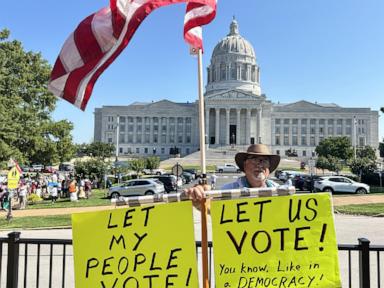
# Missouri's Redistricting Battle Creates Election Chaos Two Months Before November Vote
Missouri faces a tangled redistricting crisis that threatens to confuse voters and disrupt the state's November elections. The confusion stems from conflicting court rulings and competing redistricting plans that have left the state's congressional map unsettled with ballots due to print soon.
The state's Republican-controlled legislature passed a redistricting plan following the 2020 Census, but Democrats challenged the map in court. A Missouri state court ruled the original plan violated the state constitution and ordered a new map drawn. However, a federal court injected additional complexity by issuing its own ruling on the matter. These competing judicial decisions created parallel redistricting processes, leaving uncertainty about which map would ultimately govern November's elections.
The timing adds urgency to the crisis. Election officials need finalized districts weeks before Election Day to prepare ballots, recruit poll workers, and organize voting locations. With the November election just two months away, the window for resolution narrows daily. State and local election administrators have expressed concerns that late-breaking changes could lead to printed ballots that don't match actual district boundaries, forcing provisional ballots and confusing voters about where they should cast votes.
Missouri's congressional map directly affects eight representatives and influences control of the U.S. House. The state currently sends five Republicans and three Democrats to Congress. Redistricting fights in Missouri follow a pattern seen nationwide after 2020, where both parties aggressively pursued favorable maps. Democrats argued the GOP-drawn plan packed Democratic voters into safe districts while spreading Republican voters across lean Republican seats, violating state constitutional provisions against partisan gerrymandering. Republicans countered that the map reflected legitimate political considerations and demographic patterns.
The competing court rulings left the state in legal limbo. Missouri's highest court signaled one direction while federal judges suggested another. Resolving this conflict typically requires either the U.S. Supreme Court stepping in or state and federal judges coordinating a settlement. Neither outcome seemed imminent heading into late summer.
Election officials across Missouri warned of practical headaches. Poll workers in some precincts might receive instructions listing different districts than what voters expected based on mailings or campaign advertisements. Early voting could proceed under one map, only to have Election Day voting conducted under different boundaries. Such scenarios risk depressed turnout and litigation over election results.
The state legislature held the power to break the deadlock by passing a new map acceptable to courts, but Republicans and Democrats remained deadlocked. Passing a map required cooperation neither party seemed willing to provide.
The Missouri situation reflects broader post-2020 redistricting wars that have consumed multiple states. Courts increasingly scrutinize maps for partisan intent, but applying constitutional standards remains inconsistent. Missouri's dual-court approach created an unusually messy scenario where no single authority wielded clear control.
For Missouri voters, the confusion served as a reminder that redistricting battles extend far beyond academic debates about fairness. When courts disagree about remedy, ordinary voters face practical chaos at the ballot box.