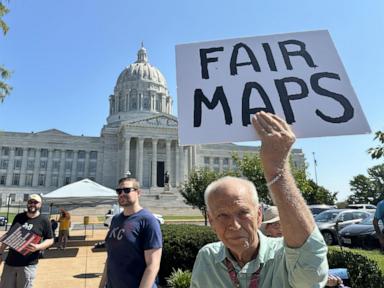
# Competing Court Orders Add Confusion to Missouri Congressional Elections
Two conflicting judicial rulings have thrown Missouri's congressional map into legal limbo with less than two months before voters head to the polls. The dueling orders from different courts have left state election officials, campaign operatives, and voters scrambling to understand which boundaries will govern the 2024 midterm races.
The clash stems from competing challenges to Missouri's current congressional district lines. One court has ruled the existing map unconstitutional on grounds of partisan gerrymandering or racial dilution, while another has blocked that decision and upheld the current boundaries. This collision of legal authority creates an immediate governance problem. The state election commission cannot issue final ballots or official candidate information packets until courts resolve which map takes precedence.
Missouri's Republican-controlled legislature drew the current map following the 2020 census. Democrats and voting rights groups challenged it, arguing the configuration dilutes minority voting power and entrenches Republican dominance across eight congressional districts. A federal judge sided with the challengers and ordered adoption of an alternative map that would create more competitive seats, particularly in urban areas where Democratic voters concentrate.
State Republicans appealed the decision to a higher court, which then issued a stay blocking the lower court's order. This procedural maneuver froze implementation of the new map and reinstated the original boundaries temporarily. However, the original court order remained technically in place, creating the competing directives that now confound election administration.
The timing intensifies pressure on all parties. Eight weeks provides barely enough time to implement a new congressional map if one is ultimately ordered. Election officials need roughly six weeks to reprogram ballot-marking equipment, produce sample ballots, and update voter rolls to reflect new district assignments. Candidates currently running under one set of districts face potential invalidation if boundaries change, forcing them to reconsider whether they even remain in their current districts.
This scenario has played out before in redistricting disputes. The 2022 cycle saw similar delays in states like Pennsylvania, New Mexico, and Arizona where courts intervened in congressional maps shortly before election day. The disruption typically advantages incumbents in the original districts and creates logistical nightmares for county election boards.
Missouri's situation also carries partisan weight. If courts impose the alternative map before the election, Republican-held seats could face genuine competitive threat for the first time in a decade. Democratic strategists see opportunity to flip traditionally red districts. Republicans argue the lower court overreached and that voters, not judges, should settle map disputes through the electoral process.
The state Supreme Court will likely need to intervene to break the deadlock between the competing orders. Its decision will determine not only which districts exist for 2024 but also signal how aggressively Missouri courts will police redistricting practices going forward. A ruling favoring the original map strengthens Republican gerrymandering defenses. A decision backing the alternative map opens the door for future legal challenges to any partisan-tilted boundary.
Election Day remains fixed at November 5. The clock is ticking for legal resolution.