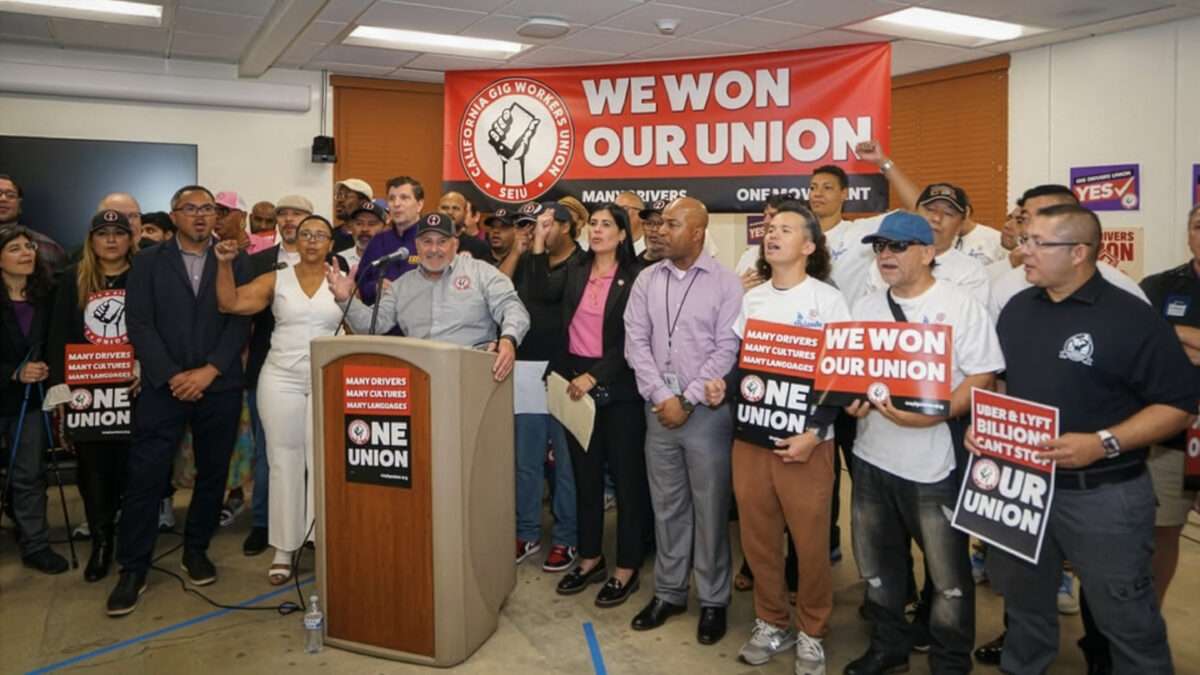
California certified a statewide rideshare workers union in September under a sectoral bargaining law that allows the California Gig Workers Union to negotiate directly with Uber and Lyft on behalf of all rideshare drivers in the state. The agreement will set industry-wide standards for rideshare across California.
California joined Massachusetts and Illinois in passing sectoral bargaining laws for the gig economy. Massachusetts passed the first such law in 2024, California in 2025, and Illinois in 2026. These laws enable sector-wide negotiations rather than company-by-company union talks.
Under California's law, a union needs to demonstrate 10 percent support among active gig drivers to receive a contact list of all remaining active drivers from gig companies. Once a union reaches 30 percent support among active drivers, it becomes certified unless a competing union also demonstrates 30 percent support. The law defines "active drivers" as those who provided the median number of rides over a six-month period, and excludes drivers with fewer than 20 rides.
The California Gig Workers Union has achieved recognition and will begin bargaining with Lyft and Uber. In Massachusetts, the statewide drivers union has already negotiated with rideshare companies for several months.
These sectoral models remain confined to the gig economy because gig workers are independent contractors not covered by the National Labor Relations Act. Harvard's Center for Labor and a Just Economy released a model sectoral bargaining law for non-covered industries like agriculture and domestic service. Benjamin Sachs, faculty co-director of the center, has advanced legal theories to expand sectoral bargaining, including the idea that a union-friendly National Labor Relations Board could "decline to assert jurisdiction" over certain categories of employers, potentially enabling states to extend sectoral bargaining to other industries.