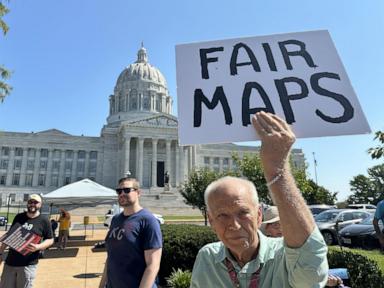
A federal appeals court panel is currently weighing whether to reinstate Missouri's congressional districts after the U.S. Supreme Court blocked the map earlier this year. The case centers on a redistricting plan that received support from former President Donald Trump and involves ongoing disputes over how Missouri's congressional boundaries should be drawn.
The Supreme Court's earlier intervention halted the implementation of the contested map, but the appeals court is now reviewing arguments about whether the original ruling was justified. This development keeps the redistricting fight alive in federal courts despite the high court's initial decision to block the plan.
Missouri's congressional redistricting has become a partisan battleground. The state's Republican-controlled legislature advanced the map in question, which would have altered district lines affecting multiple congressional races. Trump's public backing of the plan signaled its alignment with the former president's political interests, though the specific details of how the map would benefit Republican candidates remain part of the broader litigation.
The appeals court's reconsideration raises fundamental questions about judicial authority and the proper timeline for resolving redistricting disputes. Federal courts typically hesitate to intervene in redistricting matters, viewing them as primarily legislative functions. However, courts also have authority to block maps that violate constitutional requirements or federal voting rights law. The Supreme Court's initial block suggests concerns existed about the map's legality, though the full reasoning behind that decision shapes how lower courts must now approach their review.
Redistricting disputes frequently land in federal courts after state legislatures draw new boundaries following the decennial census. Missouri's situation reflects broader national tensions over partisan gerrymandering, where politicians attempt to draw district lines favoring their party. Courts face pressure to resolve these cases quickly because election timelines are rigid. Delays in finalizing congressional maps can disrupt campaign preparation and candidate recruitment.
The appeals court panel's consideration of the map demonstrates that redistricting battles rarely end with a single judicial ruling. Multiple courts may review the same map under different legal theories. The panel must now determine whether the Supreme Court's block should remain in place pending further litigation or whether the lower courts should permit the map to take effect while the case continues.
State officials and political parties on both sides have invested considerable resources in this dispute. Republicans supporting the map argue it reflects legitimate legislative choices about district configuration. Opponents contend it violates voting rights protections or constitutional requirements regarding fair representation. The appeals court's eventual decision will influence whether Missouri uses this map for the next election cycle or reverts to alternative boundaries.
The outcome carries consequences beyond Missouri. Redistricting cases consistently produce appellate decisions that shape how courts nationwide handle similar disputes. A ruling that favors map proponents could embolden other states to defend contested boundaries through federal courts. Conversely, a decision blocking the map reinforces judicial skepticism toward aggressive partisan redistricting.
The panel's work continues a pattern of redistricting litigation that has consumed federal courts since the 2020 census. These cases test the balance between judicial authority and legislative prerogative in drawing district lines, while elections loom and voters await clarity about their congressional representatives.