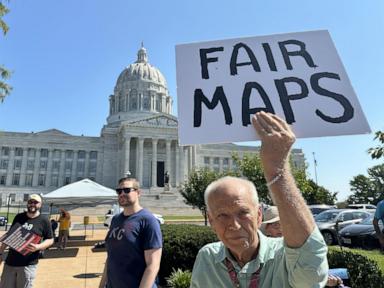
# Appeals Court Revives Trump-Backed Missouri Congressional Map Despite Supreme Court Rejection
A federal appeals court panel is now weighing whether to resurrect a Republican-drawn Missouri congressional map that the Supreme Court previously rejected, in a move that tests the limits of redistricting authority and reflects deepening partisan divisions over electoral maps.
The case centers on Missouri's congressional districts, which Republicans redrew to maximize their electoral advantage. Trump backed this particular map configuration, signaling his preference for how the state's congressional seats should be apportioned. The Supreme Court had blocked the map, effectively halting its implementation.
Now the U.S. Court of Appeals is reconsidering whether to allow the map to proceed. The panel's decision could have immediate consequences for Missouri's upcoming elections and set precedent for how courts handle redistricting disputes nationwide.
Missouri Republicans argue the map reflects legitimate state interests and population shifts revealed by the 2020 census. They contend courts should defer to state legislatures on redistricting matters. The state's GOP-controlled legislature passed the map with Trump's endorsement, positioning it as reflecting voter preferences in a Republican-leaning state.
Democrats and voting rights advocates oppose reinstatement. They argue the map constitutes partisan gerrymandering that dilutes Democratic voting power and violates the Voting Rights Act by packing Black voters into fewer districts. Civil rights groups contend the map represents an extreme partisan gerrymander designed to entrench Republican control regardless of actual voting patterns.
The Supreme Court's earlier block suggested skepticism about the map's legality. Courts typically intervene in redistricting only when maps violate the Constitution or federal law. The high court's decision to reject the Missouri map indicated the justices believed serious legal problems existed.
The appeals court now faces a narrow question: whether to overturn the Supreme Court's determination or uphold it pending further proceedings. This procedural decision will likely determine whether the map takes effect before the next election cycle, affecting which version of Missouri's districts voters cast ballots within.
Republicans have pursued aggressive redistricting across multiple states since winning the 2020 midterm elections, seeking to maximize their House majority. Missouri represents one flashpoint in broader litigation over whether states have nearly unlimited power to draw electoral maps or face judicial constraints.
Democrats have filed counter-litigation in multiple states challenging Republican maps. The issue remains unsettled in federal law despite decades of redistricting disputes. The Supreme Court has restricted challenges to partisan gerrymandering in recent years, making state courts and regional appeals panels increasingly important venues for these battles.
Trump's involvement adds political weight to the Missouri dispute. His endorsement signals Republican leadership's priority regarding state electoral architecture heading into 2024.
The appeals court panel's decision will clarify whether rejected maps can be revived through successive appeals or whether Supreme Court blocks carry finality. The ruling affects not only Missouri but also signposts how courts will handle redistricting disputes nationally through the 2024 election cycle and beyond.