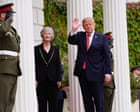
Donald Trump injected himself into one of Europe's most sensitive constitutional questions during a visit to Ireland, endorsing Irish unification and suggesting the change should occur immediately rather than waiting for future generations.
"I would love to see a united Ireland," Trump said Saturday while visiting the Irish Republic. "It's going to happen eventually, so may as well happen now." The statement represented an explicit endorsement of constitutional change that would merge Northern Ireland with the Republic of Ireland, ending the partition that has existed since 1921.
Trump's comments carried weight beyond typical diplomatic remarks. As the sitting US president and someone with Irish ancestry, his words carried symbolic value for Irish nationalists while creating immediate diplomatic friction with London and Belfast's unionist establishment. The intervention proved especially notable because American presidents typically avoid direct commentary on Irish unification, respecting the sovereignty of both the UK and Ireland on this historically fraught issue.
The UK government responded swiftly. British officials rejected Trump's characterization, reaffirming that any change to Northern Ireland's constitutional status requires the consent of its population through a border poll, a mechanism enshrined in the Good Friday Agreement of 1998. That peace framework explicitly permits a vote on unification but requires the Secretary of State for Northern Ireland to call one only when there exists a reasonable likelihood that a majority would support change.
Northern Ireland's unionist parties, particularly the Democratic Unionist Party and the Ulster Unionist Party, condemned Trump's remarks as inappropriate foreign interference. They emphasized that unionists constitute a substantial portion of Northern Ireland's population and that any constitutional change must reflect genuine demographic and electoral shifts, not external pressure or preference.
The timing of Trump's comments during a presidential visit to the Irish Republic carried political significance. Trump traveled to Ireland as part of his broader European engagement, and his remarks aligned rhetorically with Irish nationalist sentiment that has grown more vocal in recent years. Some polling data suggests shifting demographics and generational attitudes could eventually produce majorities favoring unification, though current surveys remain mixed on the question.
Trump's intervention highlighted a broader pattern in his presidency. He frequently expresses personal positions on international questions with minimal regard for diplomatic protocol or established frameworks. His comments on Irish unification lacked the careful calibration typically employed by American officials handling issues involving NATO allies like the United Kingdom.
Irish government officials did not immediately echo Trump's endorsement. While Irish nationalists welcomed his remarks, the government in Dublin exercises restraint on unification advocacy, preferring to frame the issue as one for Irish voters across the island to decide through proper constitutional mechanisms rather than external cheerleading.
The Good Friday Agreement remains the governing document for any future constitutional change. That framework has held for over two decades and established peaceful processes for addressing the unification question. Trump's suggestion that unification "may as well happen now" disregards both the agreement's procedural requirements and the genuine political divisions that persist across Northern Ireland.