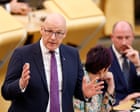
John Swinney, Scotland's First Minister, reaffirmed his government's commitment to impose legally binding price caps on essential food items including bread and milk, despite sustained opposition from farming and retail sectors who view the policy as economically damaging.
Swinney announced the price cap initiative as part of the Scottish National Party's government agenda statement on Tuesday, positioning it as consumer protection during a period of elevated food inflation. The policy would establish maximum retail prices on basic foodstuffs, a direct intervention in Scotland's market that stands apart from UK-wide approaches to cost-of-living pressures.
The plan faces substantial headwinds from industry. Farming groups and business organizations have characterized the proposal as a "potty gimmick," arguing that price controls risk disrupting supply chains, reducing retailer margins, and potentially limiting product availability. Their resistance reflects conventional economic concerns about government price-fixing mechanisms, which economists across the ideological spectrum have traditionally warned can create shortages and reduce producer incentives.
Swinney framed the policy differently. He positioned price caps as delivering "greater peace of mind" to Scottish families confronting what he presented as unmanageable food costs. This messaging targets working and lower-income households who spend disproportionate shares of household budgets on groceries. The SNP leader's persistence on this pledge demonstrates confidence in the political appeal of direct consumer protection, even as business stakeholders mount organized resistance.
The Scottish government faces implementation challenges beyond industry opposition. Legal frameworks would require clear definitions of which products qualify as "essential," how prices connect to production and distribution costs, and enforcement mechanisms when retailers resist compliance. Similar price-cap experiments in other jurisdictions have produced mixed results, ranging from reduced availability to administrative burden on enforcement bodies.
Swinney's continued advocacy reflects the SNP's broader positioning as a pro-intervention party willing to challenge market forces when leaders judge consumer welfare at stake. Scottish devolution grants the parliament authority over many domestic policies, including consumer protection, though food pricing intersects with UK trade policy and cross-border retail operations that complicate unilateral Scottish action.
The announcement appears designed to solidify SNP support among cost-squeezed voters ahead of future elections while demonstrating legislative activity on kitchen-table issues. However, the policy's actual viability depends on parliamentary approval, detailed policy design, and sustained government commitment through inevitable implementation obstacles.
Opposition parties will likely scrutinize both the practical feasibility and the economic logic of the proposal. Business groups signaled their intent to challenge the policy, suggesting Swinney should expect continued pushback from retail giants like Tesco and Sainsbury's that operate across Scotland and face complicated pricing structures.
The price cap pledge represents a genuine point of political differentiation for the SNP. Rather than pursuing conventional inflation-fighting measures like interest rate adjustments or fiscal policy, Swinney chose direct market intervention aimed at a specific constituency. Whether that choice yields political benefits or practical success remains uncertain, but the First Minister's renewed commitment signals the SNP intends to make this a centerpiece of its economic messaging.