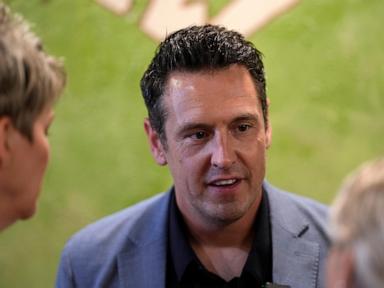
# Iowa Republican Zach Lahn Builds Outsider Campaign for Governor's Race
Zach Lahn, the Republican nominee for Iowa governor, positions himself as an outsider willing to challenge establishment politics in the state. His campaign hinges on a message of disruption and fresh leadership, departing from traditional Republican playbooks that have dominated Iowa politics for decades.
Lahn's candidacy reflects broader tensions within the Republican Party between establishment figures and populist challengers. As the GOP nominee, he carries the party's standard into what shapes up as a competitive race. Iowa has leaned Republican in recent years, but gubernatorial contests remain fluid. The state elected Democrat Kim Reynolds in 2018 and reelected her in 2022, meaning Iowa voters have shown willingness to switch parties.
The Republican's outsider positioning carries both opportunity and risk. Voters attracted to anti-establishment messaging may find Lahn's approach refreshing. Those preferring experience and political networks may view his lack of traditional credentials as disqualifying. Iowa politics has historically rewarded candidates who understand the state's agricultural economy, local governance structures, and relationship-dependent networks. Lahn's challenge involves bridging that divide.
His campaign message emphasizes breaking with how things have operated. Republican insiders in Iowa have controlled statewide offices and maintained legislative majorities. Lahn's willingness to question that structure appeals to a portion of the GOP base frustrated with the status quo. This mirrors national Republican dynamics where outsider candidates have gained traction against establishment opponents.
The timing matters for Iowa politics. Governors control significant budgetary and appointment authority. The state's budget pressures, education funding debates, and agricultural policy provide substantive terrain for the campaign. Lahn's outsider message must eventually translate into concrete policy positions on these issues.
Reynolds, the current Republican governor, leaves office having served two terms. This creates an open seat, removing the incumbent advantage from the calculation. Both parties view the race as genuinely competitive. Democrats nominate their own challenger, while Lahn represents Republicans' best positioning to retain the governor's mansion.
Lahn's background as an outsider differs from Reynolds' political experience. Reynolds served as lieutenant governor before winning the top job. Lahn enters without that extensive government service. This contrast shapes how voters perceive each candidate's readiness for executive office.
The campaign raises questions about what Iowa Republicans want from their party. Do voters in the state reward political newcomers with proven track records in government, or do they embrace candidates who promise to disrupt existing power structures? That answer will emerge through the election cycle.
National Republican attention may focus on Iowa depending on how competitive the race becomes. Gubernatorial races often test messaging and strategies later deployed in presidential campaigns. A strong Lahn performance could validate outsider Republican approaches. Underperformance might signal limits to that strategy in purple states like Iowa.
Lahn faces the fundamental challenge of converting curiosity about an outsider into votes. Iowa voters express skepticism toward politics as usual, yet they also respect candidates who understand their state's economy and governance challenges. How effectively Lahn bridges that divide determines whether his outsider bid succeeds or falters.