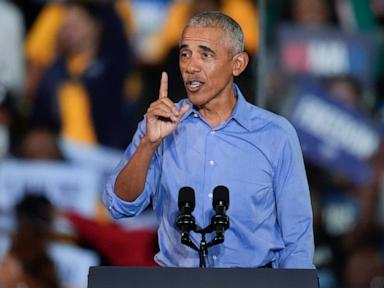
Former President Barack Obama plans to campaign in Ohio for Democratic candidates competing in the state's Senate and gubernatorial races, expanding his involvement in midterm politics as Election Day approaches.
Obama's Ohio visit marks an escalation in his engagement with 2024 campaign activities. The former president has become an increasingly visible surrogate for Democratic candidates nationwide, leveraging his continued popularity within the party to boost turnout and fundraising efforts. His decision to travel to Ohio reflects the state's status as a perennial battleground with considerable electoral consequences.
Ohio holds particular importance in this cycle. The state has shifted rightward in recent years, making Democratic victories harder to achieve but not impossible. Senator Sherrod Brown, a Democrat first elected in 2006, faces reelection against Republican challenger Bernie Moreno in one of the nation's most competitive Senate races. Control of the Senate hinges partly on outcomes in states like Ohio, where Democrats must either hold existing seats or flip Republican-held chambers.
The gubernatorial race adds another layer to Obama's outreach. Democratic candidates in Ohio seek to maintain or reclaim executive power in a state where Republicans have held recent advantage. These races determine control over redistricting, education policy, and state budgets, making gubernatorial contests essential to long-term Democratic strategy.
Obama's campaigning reflects the Democratic National Committee's broader strategy to deploy high-profile surrogates in crucial swing states. His presence carries specific weight. As a former president who won Ohio twice during his elections in 2008 and 2012, Obama retains credibility with voters in the state. He also commands media attention that amplifies campaign messaging beyond direct voter contact.
The timing of his Ohio visit carries strategic weight. Election Day approaches, meaning campaigns focus on mobilizing likely voters and persuading undecided ones. Surrogate appearances typically concentrate in the final weeks when impact peaks. Obama's schedule across multiple states suggests Democrats view numerous races as competitive and winnable.
Obama has previously campaigned for Democratic candidates in other states and continues to maintain influence within party circles despite leaving office in 2017. His involvement distinguishes races as priorities for national Democratic leadership. When former presidents campaign, local candidates gain access to larger donor networks and media platforms unavailable through local fundraising alone.
Republicans have countered Democratic surrogate efforts with their own strategy, deploying prominent GOP figures to competitive states. This surrogate arms race has become standard in modern American politics, with each party seeking to maximize enthusiasm and turnout among core supporters while persuading swing voters.
The effectiveness of surrogate campaigning remains debated among political analysts. Some research suggests that high-profile appearances boost turnout among party faithful and generate favorable media coverage. Other analyses question whether surrogate visits materially change electoral outcomes beyond what local organizing and candidate quality already determine.
Obama's Ohio campaign stop underscores how Democratic leadership views the state as winnable and competitive. His participation signals national party commitment to supporting Brown and other Ohio Democrats against Republican opponents. The visit provides ammunition for local campaign efforts and demonstrates to voters that party leaders take Ohio's races seriously enough to deploy former presidents.