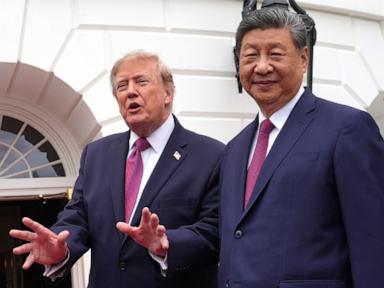
President Donald Trump used a White House tour with Chinese leader Xi Jinping on Thursday to showcase American military hardware and recent presidential upgrades, a move reflecting Trump's preference for personal diplomacy and tangible displays of power.
Trump walked Xi around the White House grounds, taking particular pride in demonstrating Marine One, the presidential helicopter, and a newly constructed helipad at the presidential residence. The informal setting allowed Trump to combine leisure with statecraft, a familiar pattern in his approach to high-stakes diplomatic encounters.
The Marine One demonstration carries symbolic weight in international relations. The aircraft represents the mobility and security apparatus surrounding the U.S. presidency, and showcasing it sends a message about American military capability and technological superiority. The newly built helipad similarly underscores investments in presidential infrastructure and operational readiness at the nation's executive seat.
Trump's tendency toward personal relationship-building in diplomacy shapes his approach to the U.S.-China relationship, one of the world's most complex geopolitical dynamics. Rather than relying solely on formal diplomatic channels or policy briefings, Trump opts to create informal moments designed to establish personal rapport with foreign leaders. This strategy reflects his broader worldview that personal relationships between leaders can transcend institutional tensions.
The Xi visit arrives amid an ongoing trade dispute between Washington and Beijing. The U.S. and China have engaged in tit-for-tat tariff increases, supply chain realignment, and technology export restrictions under both Trump's first term and the Biden administration. Trump's preference for personal engagement suggests his administration may pursue negotiated settlements through direct leader-to-leader discussion rather than through existing trade mechanisms or intermediaries.
The timing of such a tour matters in diplomatic protocol. Receiving a visiting head of state at the White House represents high ceremonial standing, and the informal showing of presidential assets and spaces conveys hospitality while reinforcing messages about American strength. Xi's willingness to participate in such a tour indicates both leaders view the relationship as worth investing personal time in, despite fundamental strategic competition between the nations.
Trump's approach contrasts with more formal diplomatic traditions that compartmentalize policy discussion from social interaction. His method blends the personal and the political, using shared experiences and informal settings as platforms for negotiation and relationship development. Whether this strategy generates substantive policy movement on trade, technology, or military tensions remains an open question.
The White House tour represented a diplomatic opening after months of confrontational rhetoric regarding tariffs, supply chain security, and technology competition. Both nations face incentives to manage their relationship constructively, and informal summits like this one can establish atmospherics conducive to negotiation. The demonstration of Marine One and presidential infrastructure served Trump's demonstrated preference for tangible, visible displays that reinforce his authority and the power of his office.