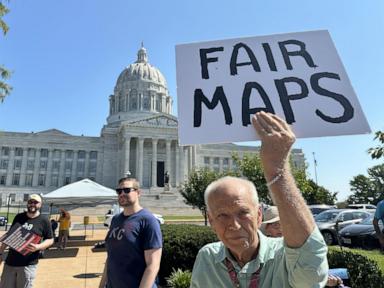
Missouri's congressional redistricting battle has escalated to the Supreme Court for a third time, placing the justices in the middle of a partisan dispute over voting maps in a reliably Republican state.
The case centers on a map that was backed by former President Donald Trump and his allies. Republican legislators in Missouri drew the current congressional boundaries after the 2020 census, creating a configuration that favors GOP candidates. Democrats and voting rights advocates have challenged the map, arguing it dilutes minority voting power and violates the Voting Rights Act.
This marks the third Supreme Court appearance for Missouri's redistricting dispute. The repeated returns to the nation's highest court underscore the intractable nature of the conflict and the difficulty of settling redistricting cases through lower courts. Previous rulings have failed to produce a lasting resolution, forcing the issue back before the nine justices.
The stakes extend beyond Missouri. The case touches on fundamental questions about congressional redistricting, minority representation, and the scope of the Voting Rights Act. How the Supreme Court rules could influence redistricting battles in other states and shape the legal framework for decades of future map-drawing exercises.
Trump's explicit backing of the Missouri map demonstrates his ongoing influence over Republican redistricting strategy. His endorsement signals to GOP leaders nationwide that aggressive, party-friendly maps have presidential support. This creates political pressure on Republican-controlled legislatures to draw maps that maximize GOP advantage.
The legal arguments focus on whether Missouri's map properly accounts for communities of color and their ability to elect representatives of their choice. Plaintiffs contend that the current boundaries intentionally pack or crack minority voters to diminish their electoral power. Republicans defending the map argue that legitimate redistricting goals, such as creating compact districts and respecting county boundaries, justify the current configuration.
The Supreme Court's conservative majority has previously taken a skeptical view of voting rights claims in recent years. In 2013, the Court gutted key provisions of the Voting Rights Act, making it harder to challenge discriminatory voting practices. This ideological lean suggests the justices may be receptive to arguments defending the Republican-drawn map.
However, redistricting cases remain complex, and even conservative justices have occasionally sided with voting rights plaintiffs when evidence of intentional discrimination emerges. The Court will likely examine Missouri's legislative intent and the map's actual effects on minority voting power.
The timing matters as well. The 2024 election cycle approaches, and any Supreme Court decision could affect which seats are competitive or safely Republican in Missouri's delegation. Both parties recognize the electoral consequences of the outcome, intensifying pressure on all three branches of government.
For Missouri specifically, a decision against the state's map could force new redistricting before the 2024 elections, creating uncertainty about district lines. A decision upholding the map would validate the Republican approach and likely resolve the dispute. Either way, the Supreme Court's ruling will establish precedent affecting how states can draw congressional districts going forward.