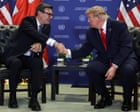
Prime Minister Keir Starmer holds his first face-to-face meeting with Donald Trump on the sidelines of the UN General Assembly in New York, with Trump telling media he maintains a "good connection" with the British leader. The bilateral encounter marks a crucial diplomatic reset between the two nations following Trump's return to prominence in American politics.
Starmer's trip to New York for the UN gathering provides the backdrop for direct engagement with the Trump administration. The meeting occurs as both governments navigate complex trade relationships and security partnerships. Trump's characterization of the relationship as positive signals openness to continued cooperation, though specifics of their discussions remain undisclosed at the time of reporting.
The timing of this encounter holds particular weight. Starmer took office in July 2024, positioning him as the first Labour Prime Minister to engage with Trump during his second term. The bilateral relationship between Britain and America traditionally ranks among the most consequential in British foreign policy, touching defense, trade, intelligence sharing, and counterterrorism cooperation.
Economic headwinds complicate the diplomatic backdrop. British homeowners face mounting mortgage pressures following geopolitical tensions. New borrowing costs triggered by Middle Eastern instability have driven average annual mortgage increases of £840 for households refinancing fixed-rate deals. Approximately one million British households have rolled off fixed-rate mortgage agreements since February, exposing them to higher variable rates. This consumer spending squeeze adds economic pressure domestically even as Starmer manages international relationships.
The Financial Times reports mortgage costs as front-page news, underscoring domestic economic anxiety. Rising interest rates ripple through household finances precisely as the Prime Minister courts American leadership on the world stage. This contrast highlights how global events and financial markets directly impact British voters' economic security.
Trade negotiations likely feature prominently in Starmer's conversations with Trump. The incoming American administration has signaled protectionist trade policies, raising questions about British exports and tariff arrangements. Post-Brexit Britain has sought independent trade deals, making the US relationship economically vital. Trump's unpredictable approach to tariffs and trade agreements creates uncertainty for British manufacturers and exporters.
Security cooperation also remains central. The UK and US share military intelligence through established frameworks and coordinate defense strategy in Europe and the Middle East. Trump's previous skepticism toward NATO commitments and overseas military engagement generated concern in British defense circles. Starmer's meeting provides an opportunity to clarify British expectations regarding defense partnerships and NATO solidarity.
The UN General Assembly setting brings together world leaders for annual speeches and bilateral negotiations. World crises dominate the agenda, including the Ukraine conflict, Middle East instability, and Indo-Pacific tensions. These global security challenges intersect with British interests at multiple points, requiring alignment with American policy where possible.
Trump's assertion of a "good connection" with Starmer appears designed to stabilize expectations and signal normalcy in the relationship. However, Trump's historical unpredictability means one meeting generates limited long-term assurance. The Prime Minister must balance public statements emphasizing partnership with practical preparations for potentially divergent interests on trade, defense spending, and alliance commitments.
The meeting represents a baseline diplomatic engagement rather than a breakthrough moment. Both leaders have incentives to maintain workable relations. Whether this translates into substantive alignment on specific policy areas remains to be seen.