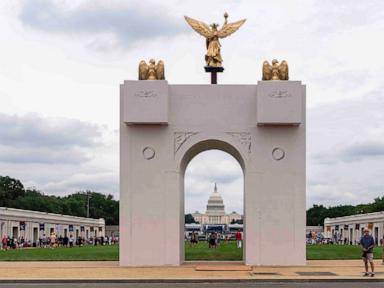
President Donald Trump unveiled plans for a massive arch monument positioned between the Lincoln Memorial and Arlington National Cemetery that would serve dual purposes as both memorial and military installation. Trump characterized the structure as a "top grade military complex" capable of hosting drone operations, sniper positions, and ammunition storage.
The proposal marks an unusual approach to monument design, blending memorial architecture with active military infrastructure. Trump presented the concept without detailing specific military capabilities, operational scope, or budget requirements. The location between two of America's most sacred sites underscores the project's intended symbolic weight.
Arlington National Cemetery serves as the nation's premier military burial ground, hosting the graves of more than 400,000 service members and their families. The Lincoln Memorial stands as one of the country's most visited monuments, attracting roughly six million visitors annually. Positioning a military complex between these two landmarks would fundamentally alter the character of the National Mall area.
Trump did not specify which military branch would operate the installation or what command structure would oversee daily operations. He provided no timeline for construction or estimated costs. The President also did not clarify how public access to the Lincoln Memorial would be affected by adding military infrastructure to the immediate vicinity.
The proposal requires approval from multiple federal agencies. The National Park Service manages the Lincoln Memorial, while the Department of Defense oversees Arlington National Cemetery. Congress would likely need to authorize any major construction project on the National Mall given its status as a protected landscape area subject to strict planning regulations.
Trump framed the arch as honoring military service while providing operational capability. He did not address potential security concerns related to positioning sniper nests and ammunition storage near the nation's most visited memorials and thousands of daily tourists.
The announcement generated immediate questions about the proposal's feasibility. Engineers would face substantial challenges constructing a military-grade complex capable of hosting drones while maintaining the aesthetic standards required on the National Mall. Structural engineers would need to balance monumental scale with functional military requirements.
No architects or engineers have been publicly named as involved in preliminary design work. Trump indicated the project remained in conceptual stages without formal architectural plans or engineering assessments currently available for public review.
The proposal aligns with Trump's broader approach to federal infrastructure projects, which often emphasizes scale and symbolic resonance. His previous initiatives included proposals for expanded military parade capabilities and enhanced national monuments celebrating military heritage.
Veterans' organizations and military leadership have not yet responded publicly to the proposal. The Department of Defense has not issued statements addressing the operational or budgetary implications of adding this installation to Washington's core memorial landscape.
The project would require extensive environmental review and community input processes before any groundbreaking could occur. Stakeholder groups managing Arlington National Cemetery and the Lincoln Memorial would gain formal voices in the approval process.