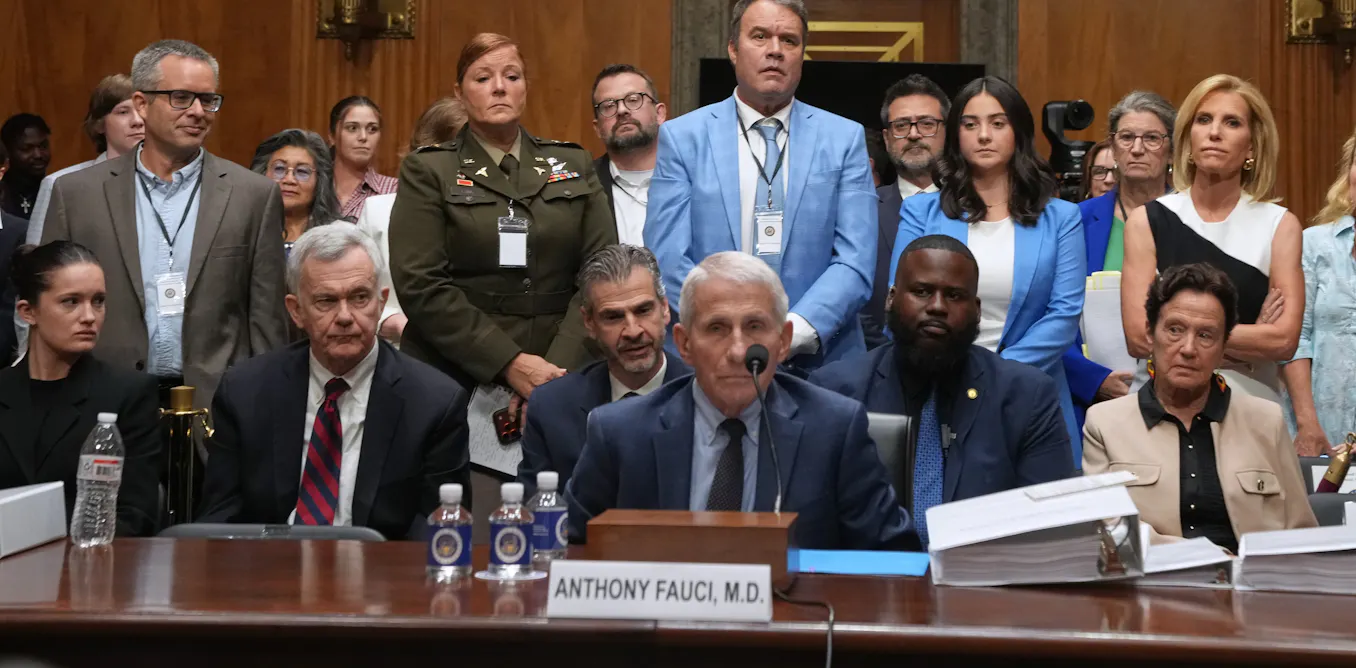
Dr. Anthony Fauci testified before Congress regarding the origins of COVID-19, with Republican lawmakers pressing him on whether the pandemic emerged from a laboratory leak rather than natural transmission. The hearing illustrated how scientific uncertainty transformed into partisan accusation, with Fauci cast as a central villain in narratives that portrayed him as complicit in the virus's creation.
Fauci, the long-serving director of the National Institute of Allergy and Infectious Diseases, became a lightning rod for conspiracy theories throughout the pandemic. Republicans seized on his early statements downplaying the lab-leak hypothesis, framing this as evidence of a cover-up rather than a reflection of evolving scientific understanding. The hearing demonstrated that conspiracy theories function less as neutral explanations and more as tools for assigning blame and identifying enemies.
The political weaponization of COVID-origins claims accelerated as the pandemic dragged on. Initial skepticism about natural origins, once dismissed by mainstream media and public health authorities, gained traction in conservative circles. By the time serious epidemiologists began acknowledging the lab-leak possibility deserved investigation, the theory had already embedded itself in partisan battle lines. Fauci's decades of public health leadership became irrelevant to his political utility as a target.
Republican lawmakers used the hearing to validate long-standing grievances. Fauci's testimony offered little new information, but the performance itself mattered more than substance. Each aggressive question reinforced the narrative that powerful figures had hidden truth from the American public.
Conspiracy theories persist because they simplify complexity and identify clear villains. The COVID-origins debate offered both. A naturally emerging virus presents no culprit. A laboratory accident points fingers at scientists, public health officials, and potentially the Chinese government. When combined with distrust of institutions and partisan polarization, these theories become politically useful regardless of evidentiary support.
The hearing revealed that conspiracy