# The Robots Cometh
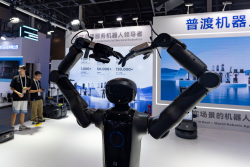
Chinese robotics company Unitree is accelerating development of humanoid robots at a pace that challenges Western competitors. The firm's latest models demonstrate capabilities in manufacturing, logistics, and service work that position China as a leader in a technology race with major geopolitical implications.
Unitree's humanoid robots perform tasks ranging from warehouse operations to construction work. The company has scaled production and reduced costs faster than established American and European robotics firms. This advancement matters because humanoid robots reshape labor markets, manufacturing competitiveness, and military applications.
The robotics sector has become a flashpoint in U.S.-China technological competition. American policymakers worry that Chinese dominance in robotics production could shift economic leverage and create defense vulnerabilities. Congressional officials have flagged the sector in broader concerns about industrial capacity and manufacturing sovereignty.
Unitree's progress reflects China's broader strategy of state-backed investment in emerging technologies. The government provides subsidies and directs capital toward robotics development as part of its "Made in China 2025" initiative. This contrasts with the more fragmented American approach, where private companies pursue robotics with limited federal coordination.
The implications extend beyond commerce. Humanoid robots reshape labor dynamics in ways that affect blue-collar workers and manufacturing regions. Economists debate whether automation creates new jobs or displaces workers faster than retraining can accommodate. The answer varies by sector and geography but carries electoral weight in manufacturing-dependent states.
Taiwan's semiconductor industry adds another layer to this competition. Advanced chips power sophisticated robotics. If China controls both chip production and robotics manufacturing, it gains leverage over global supply chains.
Western companies including Boston Dynamics and others remain competitive, but their production capacity lags Unitree's. Investment capital and government support differ markedly between American and Chinese firms, giving China structural advantages in scaling manufacturing.
The humanoid robot revolution will