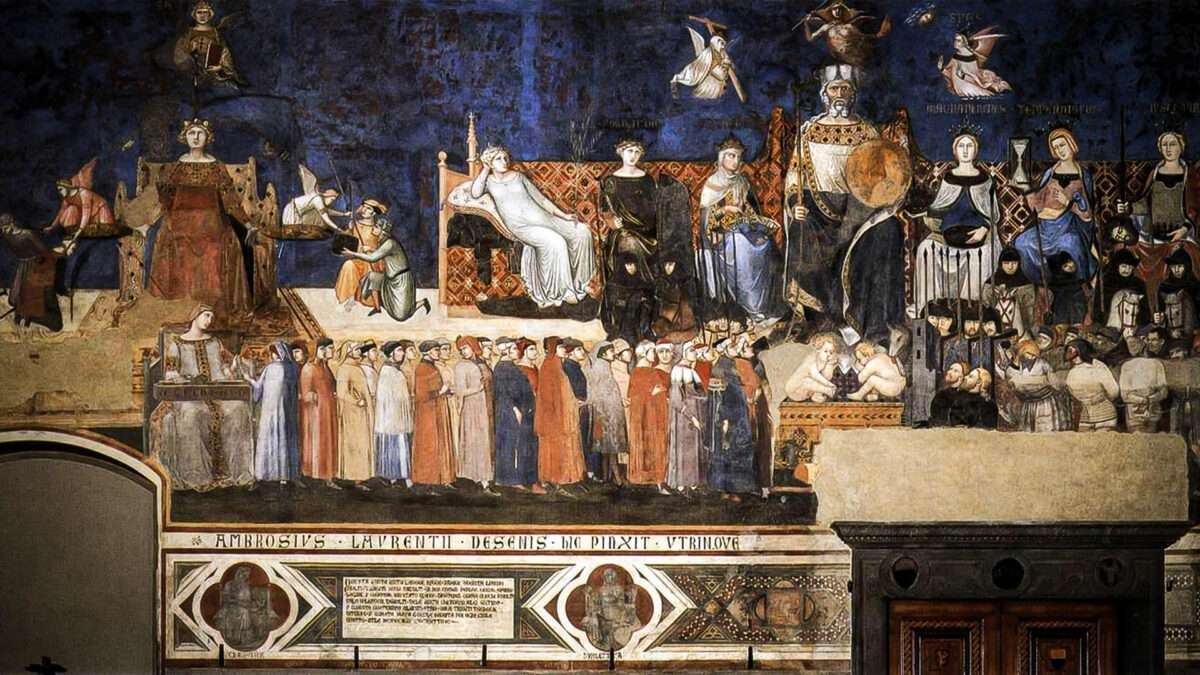
Ambrogio Lorenzetti's 14th-century fresco "Allegory of Good and Bad Government" offers a lesson for contemporary American politics, according to the analysis. The medieval Italian artwork depicts two contrasting scenes: one shows a thriving city built on voluntary cooperation where leaders serve defined roles, while the other portrays urban decay stemming from unchecked authority and the breakdown of civic order.
The fresco illustrates foundational principles about governance that resonate with current debates over executive power, institutional restraint, and civic participation. In Lorenzetti's vision of good government, prosperity emerges not from strongman leadership but from citizens engaging willingly in commerce, culture, and community life. Leaders operate within boundaries, understanding their authority comes with constraints. The bad government panel reveals the inverse: when leaders overstep, when coercion replaces consent, and when institutions collapse, economic vitality and social cohesion deteriorate rapidly.
The invocation of this 700-year-old artwork in contemporary discourse reflects broader concerns about democratic erosion and the concentration of power in executive branches across Western democracies. America faces recurring tensions between individual liberty and state authority, between executive overreach and legislative abdication. The fresco functions as a visual warning that institutional decay and authoritarian drift follow predictable patterns, and that prosperity depends fundamentally on the health of democratic norms, not the strength of individual leaders.
Lorenzetti painted during a period of Italian city-state turbulence, yet his artistic diagnosis of governance failures transcends his era. The work suggests that democracies cannot operate on fear or coercion alone, and that sustainable prosperity requires citizens to recognize their stake in maintaining institutions, limiting power, and preserving space for voluntary association.
The artwork's relevance to American political debates underscores a recurring challenge: reminding contemporary voters and leaders that checks on power, institutional respect