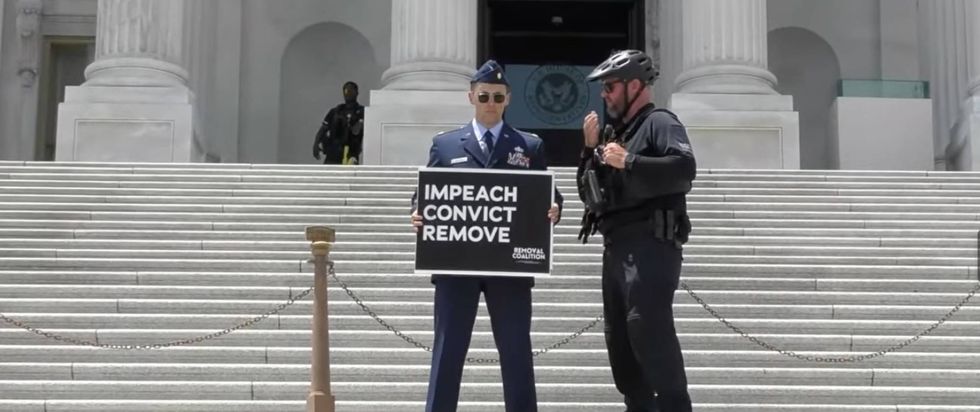
An active duty Air Force Major was arrested Wednesday for civil disobedience at the Capitol after publicly demanding President Trump's impeachment, removal, and conviction. Major Jason Watson, citing his sworn oath to defend the country "against all enemies foreign and domestic," framed his protest as a moral duty to hold a lawless president accountable.
Watson's arrest marks a striking moment of military dissent. Active duty officers rarely engage in public political protest, bound by strict codes of conduct that discourage partisan activism. Watson's decision to act breaks that tradition, positioning his military oath as superseding political constraints. He invoked the "foundational oath" language to argue that defending the Constitution against executive lawlessness transcends normal service regulations.
The timing reflects broader tensions within the armed forces. Military leadership has navigated fraught terrain since Trump's presidency, particularly around 2020 when Trump threatened to deploy active troops against domestic protesters. Pentagon officials publicly pushed back, emphasizing apolitical commitments. Watson's arrest reverses the dynamic. Rather than military brass rebuking a president, an active officer himself challenges presidential authority on constitutional grounds.
Watson's framing centers accountability. He declared "the bill must come due," suggesting consequences for what he characterizes as impeachable conduct. This language invokes both legal and moral reckoning, placing the burden on Congress to act and the nation to enforce constitutional limits.
The arrest raises questions about military discipline versus conscience. The Air Force must decide whether to prosecute Watson under the Uniform Code of Military Justice or permit his political speech as protected expression. Either path carries implications. Prosecution risks antagonizing service members who view Trump as constitutionally illegitimate. Inaction signals tolerance for active duty political activism, potentially opening doors for military officers across the political spectrum to participate in partisan protest.
Watson's statement stressed belief in American institutions and democratic process, not hostility toward the military itself.