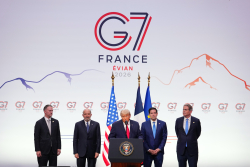
President Trump asserted American dominance at the G7 summit in France on Wednesday, declaring himself "the boss" as he joined fellow world leaders. The remark, delivered with a joking tone upon his late arrival to the meeting, reflects Trump's consistent messaging about restoring American preeminence in global affairs.
Trump has framed his administration's approach to international relations around the concept of reasserting U.S. leadership after what he characterizes as years of diminished American influence. His comment at the G7 gathering aligns with his broader foreign policy agenda, which emphasizes bilateral negotiations, skepticism of multilateral institutions, and prioritization of American interests in trade and security arrangements.
The G7 summit brought together the leaders of the world's seven largest advanced economies: the United States, United Kingdom, France, Germany, Italy, Canada, and Japan. These gatherings traditionally serve as forums for coordinating economic and security policy among allied democracies. Trump's late arrival and lighthearted assertion of dominance set a tone for discussions on trade tensions, military spending, and allied burden-sharing that have defined his approach to multilateral diplomacy.
His rhetoric about American leadership carries political weight domestically. Trump's base responds to nationalist framing that positions the United States as reasserting its rightful place atop the global order after what they view as the previous administration's overemphasis on international consensus-building.
However, Trump's assertion of American dominance comes amid ongoing trade disputes with key allies, questions about NATO commitment levels, and broader international uncertainty about American reliability in maintaining traditional alliances. The comment functioned as both diplomatic positioning and domestic messaging, reinforcing his campaign narrative about restoring American strength and authority in world affairs.