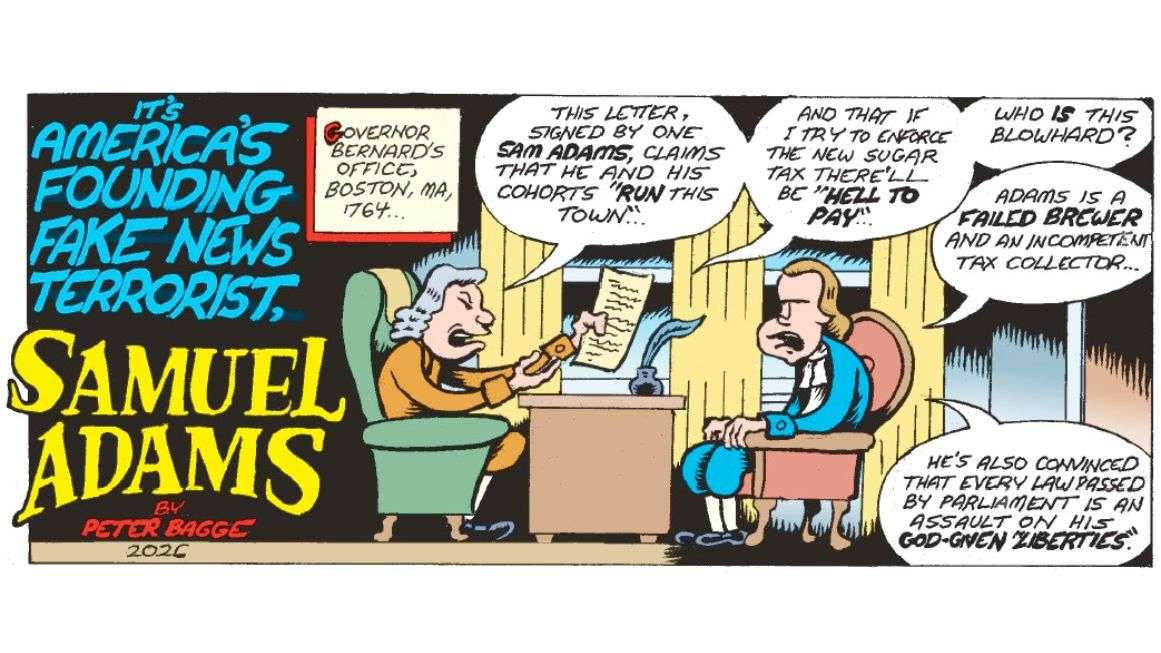
# Samuel Adams and the American Founding's Propaganda War
Samuel Adams, the cousin of future President John Adams, operated one of history's most effective disinformation campaigns during the lead-up to the American Revolution. The Boston organizer and political operative deployed inflammatory rhetoric, coordinated messaging through underground networks, and strategically amplified outrage to mobilize colonists against British rule.
Adams engineered the Boston Tea Party in 1773 as a coordinated act of political theater. He didn't simply protest taxation without representation. He orchestrated public opinion through carefully timed agitation, mob coordination, and what modern observers would recognize as propaganda. His network of activists, known as the Sons of Liberty, spread rumors, published inflammatory broadsides, and leveraged every communication channel available in colonial America.
The "Tory lackeys" reference in this comic points to Adams' relentless attacks on loyalists and moderates who opposed independence or questioned the revolutionary movement. He portrayed political opponents not as fellow citizens with different views, but as traitors in service to a tyrannical crown. This dehumanizing rhetoric justified increasingly severe measures against dissenters.
Adams excelled at what he called "political electricity." He understood that facts mattered less than emotional resonance. The Boston Massacre of 1770, where British soldiers killed five colonists, became a rallying cry under his direction. He transformed a chaotic street brawl into a symbol of British oppression, commissioning propaganda engravings and maintaining public fury years after the incident.
Modern commentators draw parallels between Adams' revolutionary agitation and contemporary political polarization. Both eras featured coordinated misinformation campaigns, dehumanization of opponents, and the weaponization of outrage for political ends. The distinction lies in cause. Adams fought against genuine imperial overreach. Contemporary political actors often amplify falsehoods without facing comparable opp