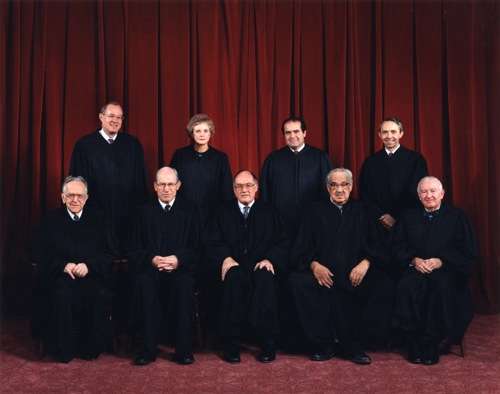
The Supreme Court upheld a Reagan-era regulation restricting federal funding for abortion counseling in Rust v. Sullivan on May 23, 1991. The case centered on a Department of Health and Human Services rule that barred clinics receiving Title X family planning funds from providing abortion-related advice or referrals to patients.
The 5-4 decision, written by Chief Justice William Rehnquist, upheld the government's authority to place conditions on federal funding without violating the First Amendment rights of healthcare providers. The majority argued that the government did not violate free speech by choosing not to fund abortion-related speech.
Justices Harry Blackmun, John Paul Stevens, Thurgood Marshall, and Sandra Day O'Connor dissented. They contended the rule imposed an impermissible gag order on doctors and violated the principle that government cannot discriminate based on viewpoint. Blackmun, who authored Roe v. Wade, wrote that the regulation transformed Title X from a program serving women's health into an ideological crusade against abortion.
The ruling created immediate controversy among reproductive rights advocates and medical organizations who argued it compromised patient care and physician integrity. The decision affected thousands of clinics nationwide that served low-income patients.
The case reflected the Court's evolving abortion jurisprudence during the early 1990s. Coming a year before Planned Parenthood v. Casey, Rust v. Sullivan demonstrated that a conservative-leaning Court would permit substantial restrictions on abortion access and funding, even when they conflicted with established medical practice.
The decision's impact persisted through subsequent administrations. President Clinton attempted to overturn the rule through executive action in 1993, while later conservative administrations reinstated versions of the funding restrictions.