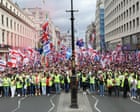
London experienced competing mass demonstrations Saturday as tens of thousands attended far-right and pro-Palestine marches simultaneously, prompting a major police operation that resulted in eleven arrests.
Metropolitan Police arrested two men near Euston station who were wanted on suspicion of grievous bodily harm following an incident in Birmingham where a man was run over. Both suspects had traveled to London to attend the Unite the Kingdom (UTK) protest, a far-right march organized by groups associated with activist Tommy Robinson.
The dual demonstrations created significant policing challenges as officers deployed across the capital to manage crowd control and prevent clashes between opposing groups. The pro-Palestine march coincided with Nakba Day commemorations, marking the displacement of Palestinians during Israel's 1948 founding. The far-right march drew supporters of nationalist and anti-immigration causes.
Police reported making arrests for "a variety of offences" beyond the two GBH suspects. The force deployed additional resources to maintain order between the competing demonstrations and prevent violence in central London.
The simultaneous marches highlighted Britain's deep polarization on two separate but interconnected issues: immigration and Middle Eastern politics. Far-right groups have increasingly mobilized around anti-immigration and anti-Islam messaging, while pro-Palestine movements have grown substantially since October 2023.
Scotland Yard's response demonstrated the logistical complexity of managing large-scale protests in a major city when opposing factions march in proximity. The arrests and police presence reflected authorities' concern about potential violence, particularly given the Birmingham incident that preceded the London march.
The events underscored ongoing tensions in British politics between nationalist movements and pro-Palestinian activism, both drawing substantial public participation despite their opposing ideologies and goals.