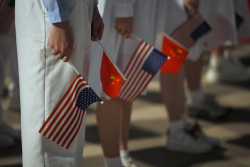
The U.S. and China have entered a period of managed tension that officials on both sides treat as preferable to either full confrontation or false harmony. This "cold peace" reflects a realistic assessment that deep ideological and economic differences prevent genuine partnership, yet both nations retain incentives to avoid direct military conflict.
Recent diplomatic engagements between Washington and Beijing have focused narrowly on preventing miscalculation rather than resolving fundamental disputes. U.S. officials, including those in the Biden administration, have abandoned the notion of engineering sweeping agreements that would transform the relationship. Instead, they concentrate on establishing clear communication channels, military-to-military protocols, and explicit red lines to reduce accident risk.
China's leadership operates from similar pragmatism. Beijing continues challenging American interests in the Taiwan Strait, South China Sea, and technology sectors, but stops short of actions that would trigger direct U.S. military response. Both capitals seem to accept that competition across trade, technology, and regional influence will persist indefinitely.
This approach differs sharply from earlier U.S. strategies. The Trump administration pursued unpredictable tariff wars and rhetoric that escalated tensions. The Obama era attempted deeper engagement with limited results. The current strategy accepts permanent rivalry while building guardrails.
The stability of cold peace depends on whether both nations honor tacit understanding about escalation thresholds. Taiwan remains the most volatile flashpoint, as does any accidental military encounter in contested waters. China's assertiveness on semiconductor technology and industrial policy tests American patience, while U.S. military operations near Chinese territory invite retaliation threats.
Experts debate whether cold peace can endure. Some argue that economic interdependence creates natural brakes on conflict. Others contend that declining American relative power eventually tempts Beijing toward aggression. Technology competition around artificial intelligence and quantum computing introduces new variables.
For now, both nations appear content avoiding grandeur