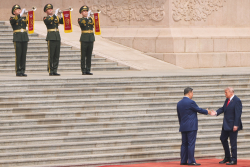
President Trump has positioned himself as uniquely capable of handling China's military threats against Taiwan, leveraging his unpredictability as a negotiating asset. Xi Jinping's recent saber-rattling over Taiwan represents Beijing's continued pressure on the self-governing island, but Trump claims his administration possesses concrete tools China respects.
Trump's argument rests on his willingness to deploy unconventional diplomacy and military posturing. Unlike previous administrations that relied on predictable responses, Trump has signaled he operates without such constraints. He has suggested that his personal relationship with Xi, combined with his demonstrated willingness to use tariffs and sanctions, gives him leverage other presidents lack.
The Taiwan question remains one of the most volatile flashpoints in U.S.-China relations. Beijing views the island as a breakaway province and has not ruled out military reunification. Washington maintains official ambiguity about its Taiwan defense commitments while providing defensive weapons systems to Taipei. This delicate balance has survived multiple administrations, but Trump contends his approach differs fundamentally.
Trump's framing implies that Xi respects strength and unpredictability over diplomatic norms. He points to his first term trade war and tariff threats as evidence that China responds to economic coercion. The implication is that Biden administration policies, which prioritized stable communication channels and multilateral coordination, projected weakness to Beijing.
However, this strategy carries risks. Saber-rattling from both sides escalates military tensions without clear off-ramps. Trump's unpredictability could miscalculate Xi's actual red lines on Taiwan, particularly if Beijing interprets American bravado as a commitment to defend the island militarily.
Taiwan's 23 million people occupy a critical geopolitical position. The island sits astride crucial semiconductor supply chains and sits directly in China's strategic sphere of influence. Any miscalculation between Washington and